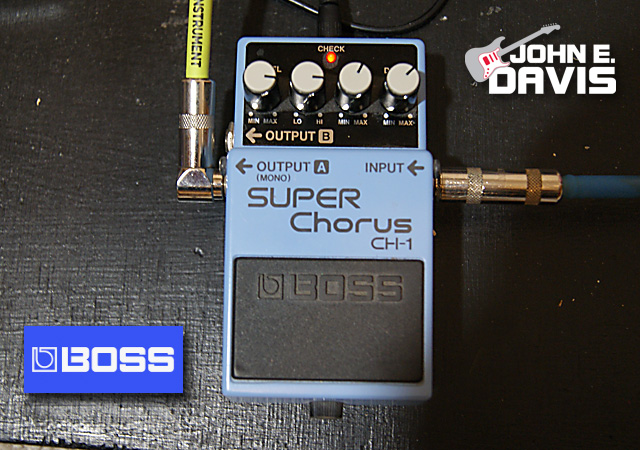
Boss CH-1 Stereo Chorus Pedal

Boss CH-1 Super Stereo Chorus
Maximize the genuine tone of the classic BOSS chorus effect: clear, shimmering, and instantly musical.

The Boss CH-1 Stereo Chorus offers classic clean and shimmering chorus tones for any guitarist or keyboardist. The Boss CH-1 Stereo Chorus’s four onboard controls let you take charge of your chorus sound with control. Crank up the rate for a dizzying psychedelic twist or pull back the rate, turn up the depth. Use the BOSS CH-1 in stereo for a lush, wide wave.

No guitar or keyboard rig is complete without a high-quality chorus effect. In addition, with the Boss CH-1 Super Chorus, you’ll be armed to dial in nearly every classic chorus sound. You can use the pedal’s four controls — Effect Level, EQ, Rate, and Depth — to sculpt the feel and dimension of your sound until it’s just right. The Boss CH-1 Stereo Chorus can take you everywhere, from shimmering clean tones to lush ambiences to boat-rocking, dizzying swirls.

Boss CH-1 Stereo Chorus Sound Qualities

Over 10 million BOSS guitar and bass effects pedals have been sold globally to musicians. Renowned artists like Yngwie Malmsteen, Dave Navarro, John Petrucci, Marty Friedman, Steve Vai, and Joe Satriani. Similarly, you’ve likely heard BOSS pedals both in recordings and live performances by bands across various genres, such as Muse, the Killers, and Silversun Pickups.

The reason for their popularity is evident: BOSS effects pedals not only deliver exceptional sound quality but are also constructed to withstand rigorous use. Each pedal is encased in a durable metal housing and features a rubberized area and base to prevent slipping.

Whether you are a complete beginner, a seasoned player building your ideal pedalboard, or somewhere in between, you can rely on BOSS’s trusted range of pedals to shape your sound.

John E. Davis is a Texas Rock Guitarist offering FREE guitar lessons videos and covers guitar equipment, concert and music news. Visit the website for information on Guitar Lessons, Guitar Repair and Live Music Performance videos.
Fender Pau Ferro Neck

Fender Pau Ferro Neck
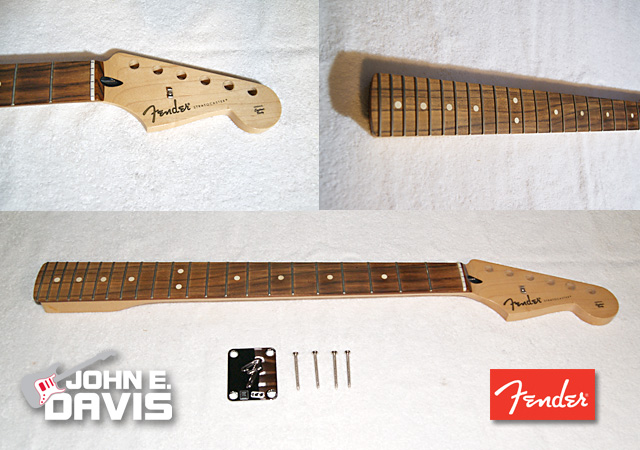
Fender Pau Ferro necks, commonly used as a modern alternative to rosewood, feature a dense, smooth, and tonally versatile hardwood.

The Fender Pau Ferro Neck often times is an alternative to rosewood on a guitar. Moreover, feature a dense, smooth, and tonally versatile hardwood (Bolivian Rosewood) that offers a slightly brighter, snappier tone. These necks are often paired with maple, offering increased stability and a distinct light-brown aesthetic with varied grain. They are frequently featured on Player Series and Deluxe Series models. 

Pau Ferro Neck Key Features & Characteristics

  • Tone: The wood is harder and denser than Indian Rosewood, providing brighter, snappier tones similar to ebony, however with better warmth than maple.
  • Feel & Appearance: Pau Ferro has a very smooth, tight grain, often described as feeling similar to ebony, and typically features a lighter, milk-chocolate color with dark streaks.
  • Common Specifications: Most Pau Ferro necks from Fender feature a 9.5″ or 12″ radius, “Modern C” profile, and 21–22 frets.
  • Usage: Used widely on Mexican-made (Ensenada) models, including Player Series Stratocaster necks.

Fender Pau Ferro Neck 60s Specs

For the repair, replacement, or restoration of your cherished instrument, guitar technicians suggest using Fender OEM parts. This authentic Fender Road Worn ’60s Stratocaster neck merges a sophisticated look with an impeccable fret-hand feel. The mid-’60s “C” profile maple neck fits comfortably in the hand, and the pau ferro fingerboard with a 7.25-inch radius is favored by vintage Strat enthusiasts.

This neck features a pilot-slotted synthetic bone nut and a spaghetti-style headstock logo. Finished with a hand-distressed nitro coating, this Fender Road Worn ’60s Stratocaster neck is sure to impress.

Pau Ferro Neck are crafted at the Ensenada, Mexico manufacturing facility, this genuine vintage-style Fender Stratocaster neck features a comfortable “C”-shaped profile and 12″-radius Pau Ferro fingerboard with 21 medium jumbo frets.

For example, the synthetic bone nut is pre-slotted with “pilot” grooves for accurate spacing when filing the final string slots, and a gloss urethane finish offers an incredibly smooth feel. This replacement neck is the perfect way to give your Strat® an authentically ’60s feel.

This replacement neck is for a Fender or Squier by Fender guitar.

John E. Davis is a Texas Rock Guitarist offering FREE guitar lessons videos and covers guitar equipment, concert and music news. Visit the website for information on Guitar Lessons, Guitar Repair and Live Music Performance videos.
The Stratocaster Pickup Selector Switch

The Stratocaster Pickup Selector Switch

Fig. 1: The Stratocaster pickup selector switch near the top of the image is set to the bridge pickup-only position (position 1).

The pickup switch is the key to the Stratocaster’s time-honored tonal versatility. The switch controls which pickups or which combinations of pickups are on at any given time. Fender Stratocasters are Fender’s sole three-pickup guitar, its pickup switch has an important job to do.

Locating the stratocaster pickup selector area

Stratocaster Pickup Selector is a five-position blade-type switch mounted diagonally on the lower half of the pick guard on the treble-strings side, just forward of the control knobs (see Fig. 1). Body location placement is close enough to the strumming/picking hand to be within easy reach. However, far enough out of the way that it’s unlikely to be accidentally knocked out of position.

If we number the switch positions 1 through 5, with position 1 being closest to the middle tone knob and positions 2, 3, 4 and 5 proceeding in order toward the middle pickup. Moreover, we can easily label the switch’s pickup-selection functions (see Fig. 2):

  • Position 1: Bridge pickup only.
  • Position 2: Bridge pickup and middle pickup together.
  • Position 3: Middle pickup only.
  • Position 4: Middle pickup and neck pickup together.
  • Position 5: Neck pickup only.

Note that there is no means of having all three pickups on at once. For example, note that there’s some quite interesting history behind the Strat’s pickup switch.

For the initial 23 years of the Stratocaster’s life, from its introduction in 1954 until 1977, the pickup selector featured a three-position switch. This allowed you to activate either the bridge pickup, the middle pickup, or the neck pickup. Therefore, Richard Smith noted in Fender: The Sound Heard ’Round the World that Leo (Fender), the guitar’s creator, preferred the unadulterated sound of individual pickups. You could only engage one pickup at a time, and that was the extent of it.

John E. Davis is a Texas Rock Guitarist offering FREE guitar lessons videos. Visit TexasRockGuitarist.com for information on Guitar Lessons, Guitar Repair and Live Music Performance.

Charvel Desolation Skatecaster SK-1

Charvel Desolation Skatecaster
The Charvel Desolation Skatecaster plays off of the original Charvel Surfcaster legacy from the 1990s. Featuring solid Mahogany everything, neck through design.

Musicradar reviewed a Charvel Desolation Skatecaster SK-1 FR and is encouraging metal players to check one out. According to the review, the SK-1′s mahogany body mates well with its pickups, resulting in an excellent tone.

“The Skatecaster’s sheer mass of mahogany helps round off any inherent abrasion from its EMG humbuckers,” said Music Radar. “And we’d suggest it gives a great Kirk Hammett-style scorching lead tone.” The review ends by giving a little background on the model and inviting metal-heads to sample the model. The Desolation series is far removed from the hot-rodded custom S-types for which Charvel is loved historically,” concludes Music Radar. “But we concede that most metal teenagers won’t care too much about that. Try one.”

Desolation Skatecaster SK-1 Key Features and details:

  • Design & Build: The SK-1 models feature a distinct offset mahogany body with a neck-through-body design and a bound mahogany neck.
  • Electronics: Active EMG 81 (bridge) and 85 (neck) pickups are standard, providing high-output, aggressive tones.
  • Hardware: Options include a solid mahogany body and neck-through design (ST) or a Floyd Rose locking tremolo (FR).
  • Fingerboard: 24 jumbo frets on a 12″-16″ compound radius rosewood fingerboard.
  • Legacy: While the original 1990s Surfcaster was designed for surf music with lipstick pickups, the Desolation series (introduced in 2011) was aimed at modern rock/metal players.

The series was generally well-regarded for its value, with many models featuring a gloss finish and a “fast” neck profile. The Desolation Skatecaster SK-1 represents a contemporary interpretation of the iconic Charvel Surfcaster from the early 1990s, featuring a solid mahogany body and a neck-through construction.

Charvel Desolation Skatecaster Neck Comments:

The Charvel Skatecaster boasts a bound mahogany neck, a rosewood fingerboard equipped with 24 jumbo frets and abalone keystone inlays, as well as abalone binding on the body and headstock. In addition, the guitar is outfitted with EMG 85 (neck) and EMG 81 (bridge) active humbucking pickups, which are controlled via a three-way toggle switch and a single volume knob.

Additionally, the Skatecaster includes a specific Charvel bridge specifically designed for compound-radius fingerboards, black nickel hardware, three-on-a-side locking Charvel tuners, and is available in solid and trans finishes with a matching headstock.

John E. Davis is a Texas Rock Guitarist offering FREE guitar lessons videos. Visit TexasRockGuitarist.com for information on Guitar Lessons, Guitar Repair and Live Music Performance.